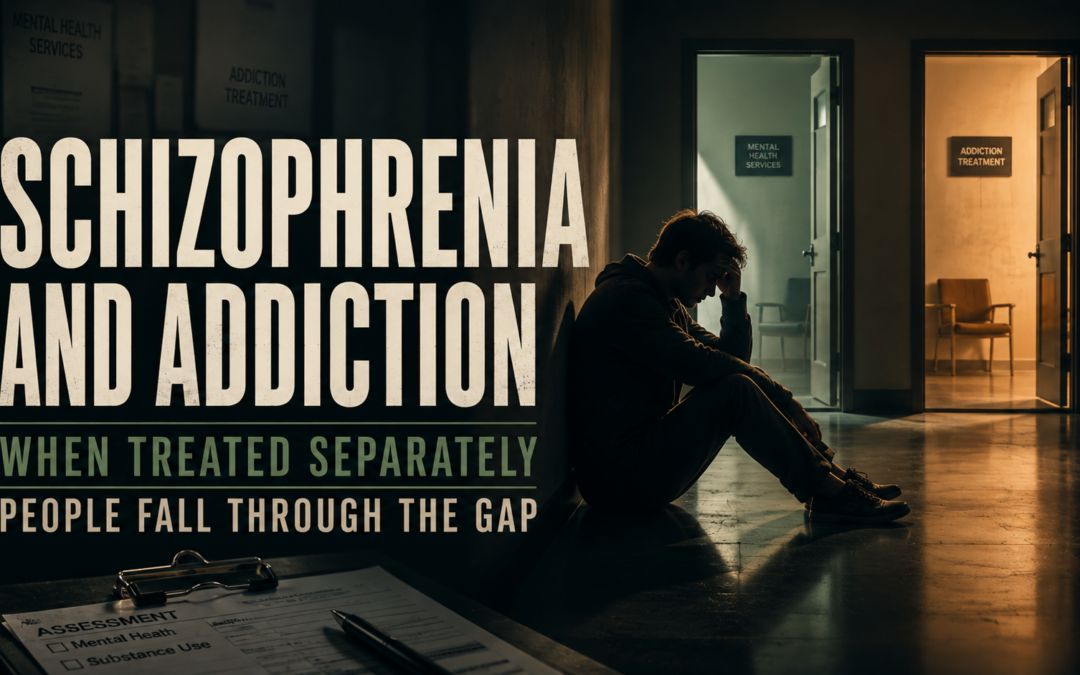
Schizophrenia and addiction treated separately almost always leaves a person caught between two systems that were never designed to talk to each other. If you or someone you love is living with both a serious mental health condition and a substance use disorder, you may already know how easy it is to feel forgotten in that gap.
One provider treats the schizophrenia. Another treats the addiction. Neither sees the whole person, and the space between them is where too many people slip.
Please know that reaching out for information is a brave and hopeful step. This article explains why divided care so often fails, what integrated treatment looks like, and how to find support that treats both conditions as one connected picture. You are not alone in this, and a better path exists.
What Do Co-occurring Schizophrenia and Addiction Look Like?
Co-occurring schizophrenia and addiction means a person is living with both a serious mental health condition and a substance use disorder at the same time. These two challenges often overlap, feed each other, and shape daily life in ways that are hard to untangle.
Schizophrenia is a mental health condition that affects how a person thinks, feels, and experiences reality. It can involve unusual thoughts, changes in perception, and difficulty with focus or motivation.
Addiction frequently enters the picture as a way to cope. Someone might use substances to quiet troubling thoughts, ease anxiety, or find a moment of relief from symptoms that feel overwhelming.
Why the two so often appear together
The two conditions appear together often because each can influence the other in a repeating loop. Substances may seem to soften symptoms for a short while, yet they usually make those symptoms harder to manage over time.
This is not a matter of weakness or poor choices. It reflects how deeply these conditions can intertwine, which is exactly why they deserve care that treats them together.
Why Does Treating Schizophrenia and Addiction Separately Fail?
Treating schizophrenia and addiction separately fails because it forces a person to split their care between two systems that rarely coordinate. When schizophrenia and addiction are treated separately, each provider sees only half the picture, and the connection between the two conditions goes unaddressed.
Mental health care and addiction care have historically operated apart. A person may see one team for their schizophrenia and a completely different team for their substance use.
Those teams often do not share information or plans. That leaves the individual carrying the burden of explaining, coordinating, and connecting their own care, all while managing two demanding conditions.
The gap where people fall through
The gap forms when neither system takes full responsibility for the whole person. A mental health provider may hesitate to treat addiction, and an addiction program may feel unequipped to handle schizophrenia.
Picture two teams standing on opposite sides of a river, each waiting for the other to build the bridge. The person in need is left standing in the water between them.
Why divided care makes recovery harder
Divided care makes recovery harder because progress in one area can quietly unravel in the other. Someone might stabilize their mental health symptoms, only to relapse because their substance use went untreated.
The reverse happens too. A person might reduce their substance use while their untreated schizophrenia symptoms grow louder and eventually pull them back toward using.
When schizophrenia and addiction are treated separately, this cycle can repeat again and again. Each round can chip away at hope, even though the person is trying with everything they have.
How Does Integrated Care Work?
Integrated care works by treating schizophrenia and addiction together, within one coordinated team and one unified plan. Instead of dividing a person between two systems, it brings all of their care under a single, connected roof.
This approach is sometimes called dual diagnosis or co-occurring disorder treatment. It rests on a simple idea. Both conditions are real, both need attention, and both respond best when treated at the same time.
A single team learns the full story. Your therapist, your prescriber, and your support staff all work from the same understanding of your needs.
One team, one plan
One coordinated team means your care no longer depends on you connecting the dots alone. Providers communicate directly, adjust the plan together, and respond to the whole picture rather than isolated pieces.
That coordination removes the mixed messages people so often receive when different providers work in silos. It also means your care can shift as you do, without forcing you to start over somewhere new.
Treating the whole person
Integrated care treats the person, not just a diagnosis or a substance. It looks at your mental health, your substance use, your physical health, and the daily life you are trying to rebuild.
When the connection between schizophrenia and addiction finally receives attention, recovery has a far greater chance of holding. You get to heal the full picture rather than one fragment of it.
What Levels of Care Support People With Co-occurring Conditions?
Several levels of care support people living with both schizophrenia and addiction, and the right fit depends on your symptoms, your safety, and your daily needs. Care can grow more intensive during hard stretches and ease back as stability returns.
Common levels of care include:
- Residential or inpatient care for structured, round-the-clock support in a calm, focused environment.
- Partial hospitalization for intensive daytime treatment with evenings spent at home.
- Intensive outpatient care for regular, structured sessions that still allow for work, school, or family life.
- Outpatient care for ongoing therapy, medication management, and steady check-ins.
A good care team helps match the level of support to where you are right now. As you grow steadier, your care can step down to something lighter, and it can step back up whenever you need more.
Why matching care to the moment matters
Matching the level of care to your current needs protects your progress and your energy. Too little support can leave you struggling, while more than you need can feel overwhelming.
The goal is always the same. Rebuild steady, predictable ground where both your mental health and your recovery can grow stronger together.
What Are the Warning Signs That Integrated Care Is Needed?
The clearest warning sign is when treating one condition keeps causing setbacks in the other. When schizophrenia and addiction are treated separately and progress keeps slipping, that pattern signals a need for coordinated care.
Watch for these signs in yourself or someone you love:
- Mental health symptoms return or worsen whenever substance use goes untreated.
- Substance use increases during periods of higher stress or symptom flares.
- Treatment for one condition seems to ignore or overlook the other entirely.
- A person cycles through programs without lasting progress.
- Medication becomes hard to manage alongside ongoing substance use.
- Providers do not communicate, leaving care disconnected and confusing.
- Withdrawal, isolation, or unusual thoughts grow more noticeable over time.
None of these signs point to failure. They are signals that care needs to treat both conditions as one connected whole.
If you or a loved one is in immediate danger or having thoughts of self-harm, please seek help right away. You can call or text the 988 Suicide and Crisis Lifeline in the United States at any time, day or night.
How Do You Decide When to Seek Integrated Treatment?
You should seek integrated treatment when both a mental health condition and substance use are present, especially when treating them separately has not brought lasting relief. You never have to reach a crisis point to deserve coordinated, compassionate care.
Use these questions to guide your decision:
- Are both schizophrenia and a substance use disorder part of the picture? This combination calls for care that treats both together.
- Has progress in one area kept slipping because of the other? That pattern signals a need for a coordinated plan.
- Have you or your loved one moved between programs without lasting change? Integrated care can close the gap that divided treatment leaves open.
- Do your providers work separately without sharing a plan? A single, connected team can ease that burden.
- Do you feel alone or overwhelmed in managing all of this? Reaching out supports both the person in treatment and the family beside them.
Answering yes to any of these does not mean something is wrong with you. It means the right kind of care is available, and you deserve it.
Common Questions Before Starting Treatment
Can schizophrenia and addiction really be treated at the same time?
Yes. Integrated programs are designed specifically to treat both conditions together within one coordinated plan. This approach tends to support more stable, lasting recovery than treating each condition separately.
Why did previous treatment not work?
Earlier treatment that addressed only one condition may have left the other unaddressed. When schizophrenia and addiction are treated separately, progress in one area can unravel in the other, which is often why past attempts did not hold.
What if my loved one does not want help?
This is a common and painful situation. Gentle, honest conversations, patience, and guidance from a professional can make a real difference over time. A caring team can also help you encourage treatment without pressure.
Is it too late to seek help?
It is not too late. People begin or return to integrated treatment at every stage, and steadier ground is possible with the right support in place.
You Do Not Have to Navigate This Alone
Schizophrenia and addiction treated separately almost always leaves a person falling through the gap between two systems, but that gap does not have to define your story or your loved one’s. When both conditions receive care together, that space closes, and real healing becomes possible.
You are not alone in this, and stability is possible with the right support around you. Integrated care honors the full truth of what you are living with, treating the whole person rather than one piece at a time.
When you feel ready, consider reaching out to a treatment provider that offers coordinated care for co-occurring conditions. A compassionate team can listen to your story, answer your questions, and help you build a plan that fits your needs. Take that next step whenever you are ready, because support is here for you.