
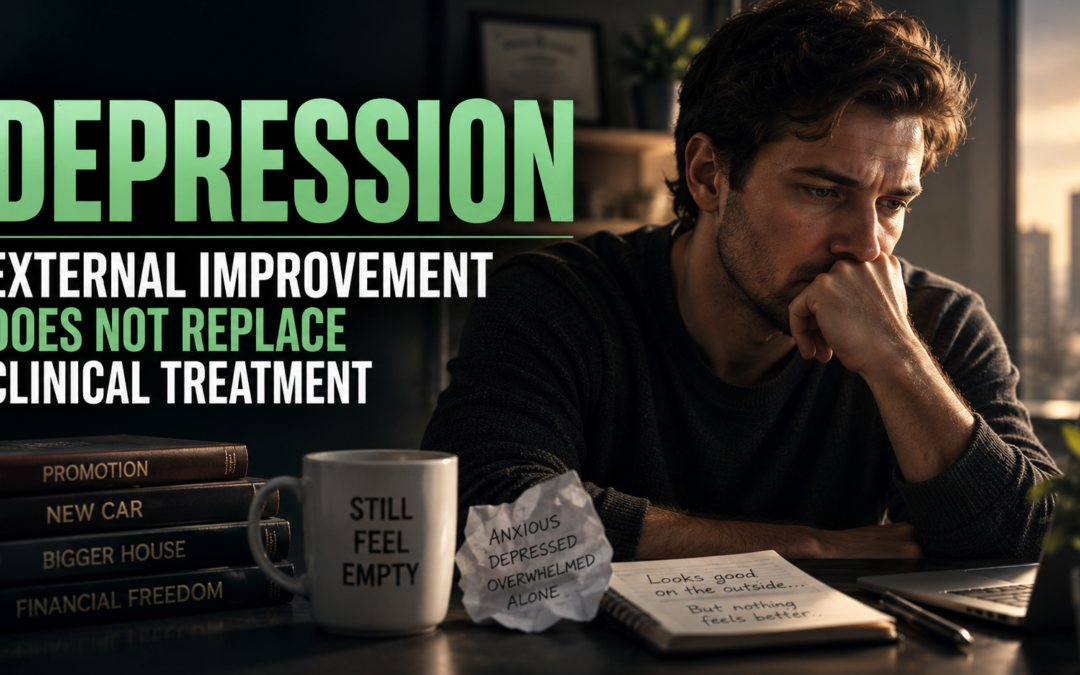
Depression clinical treatment is often the missing piece for people who have watched their lives improve on paper while their mood stayed stubbornly low. Maybe you finally got the promotion, paid off the debt, ended a stressful relationship, or moved somewhere you always wanted to live. You expected relief. Instead, the heaviness stayed.
That gap between how good things look and how empty they feel can be deeply confusing. You might blame yourself, wondering why you cannot just be grateful or happy when so much has gone right.
Please know that what you are experiencing makes sense, and it is not a personal failing. Depression is a medical condition, not a reaction to circumstances that a better life can simply fix.
This article explains why external improvements do not resolve depression, what the condition actually is, the biological reasons it needs real care, how substance use fits in, and how to find support that meets you where you are.
What Is Depression as a Medical Condition?
Depression is a medical condition that affects the brain and body, not a mood that comes and goes with your circumstances. It changes how you think, feel, sleep, and function, often for weeks, months, or longer.
Many people picture depression as ordinary sadness. Sadness usually has a cause and fades over time. Depression can settle in without a clear reason and stay long after the moment that seemed to trigger it.
This is why a good day, a new job, or a happy event may bring little relief. The condition runs deeper than any single situation.
Depression is not a choice or a weakness
Depression is not something you can decide your way out of, and struggling with it says nothing about your strength or character. It reflects real changes in the brain, much like other health conditions reflect changes in the body.
Understanding this can lift a heavy burden. When you see depression as a medical condition, reaching out for help feels far less shameful.
Why Does Depression Not Ease When Life Improves?
Depression does not ease when life improves because it is driven by internal biology, not by external events. Better circumstances cannot reach the underlying changes in the brain that keep the condition in place.
Think of it like trying to fix a broken bone by redecorating the room around it. The room may look wonderful, but the injury still needs proper medical care to heal.
Your surroundings can influence your mood, yet they do not control the deeper systems that shape depression. That is why a raise or a fresh start may barely move the weight you carry.
When good news brings guilt instead of relief
Good news can bring guilt when depression is present, because you feel you should be happy and cannot understand why you are not. That guilt often makes the depression heavier.
You might tell yourself that other people would be thrilled in your position. This kind of comparison rarely helps, and it can deepen the isolation you already feel.
Why circumstances are only part of the picture
Circumstances are only one piece of what shapes your mental health, alongside biology, history, and brain chemistry. Improving one piece does not repair the others.
This is exactly why depression clinical treatment matters so much. It addresses the parts of the condition that a better life, on its own, simply cannot touch.
Why Does Depression Require Clinical Treatment?
Depression requires clinical treatment because its biological roots respond to care that circumstances alone cannot provide. Professional treatment reaches the brain chemistry, thought patterns, and underlying causes that keep depression in place.
Depression involves changes in how the brain regulates mood, energy, and motivation. These changes are real and physical, which is why waiting for them to pass often does not work.
Clinical care meets those changes with proven tools. Therapy, medical support, and structured guidance work together to help your brain and body find steadier ground.
The biological basis of depression
The biological basis of depression involves the brain systems that manage mood, sleep, focus, and energy. When these systems fall out of balance, no amount of positive change fully corrects them on its own.
Picture a thermostat that no longer reads the temperature correctly. The room could be perfectly comfortable, yet the system keeps signaling that something is wrong. Depression can work in a similar way, which is why it needs care aimed at the system itself.
How clinical treatment helps
Clinical treatment helps by addressing depression at its source through evidence-based approaches. Therapy can shift the thought patterns that fuel low mood, while medical support can help rebalance brain chemistry when appropriate.
Approaches like cognitive behavioral therapy help you understand and change the thoughts driving your depression. Over time, these tools ease symptoms and restore a sense of meaning and steadiness.
The goal is not to force happiness. It is to treat the condition so relief can come from the inside out.
How Are Depression and Substance Use Connected?
Depression and substance use are closely connected because many people turn to alcohol or other substances to cope with low mood or emptiness. When nothing external seems to help, a substance can feel like the only source of relief.
This response is deeply human. When depression makes evenings unbearable, anything that softens the weight can seem worth it.
The relief rarely lasts. Over time, substances tend to deepen depression and add a new layer of struggle on top of the original pain.
Why treating both together matters
When depression and substance use appear together, treating them at the same time works better than treating either one alone. These are known as co-occurring conditions.
Integrated care brings your mental health support and substance use treatment into one coordinated plan. A single team works from the same understanding of your needs, so nothing important gets left behind.
This whole-person approach reaches the root of the struggle, not just the surface. When the underlying depression finally receives attention, lasting recovery becomes far more possible.
What Levels of Care Are Available for Depression?
Several levels of care are available for depression, and the right fit depends on your symptoms, your safety, and your daily responsibilities. Care can grow more intensive during harder stretches and ease back as you gain stability.
A good care team helps match the level of support to where you are right now. Common levels of care include:
- Residential or inpatient care for structured, round-the-clock support during the most difficult stretches.
- Partial hospitalization for intensive daytime treatment with evenings spent at home.
- Intensive outpatient care for regular, structured sessions that still allow for work, school, or family life.
- Outpatient care for ongoing therapy, medication support, and steady check-ins.
Many people move through several of these stages as they heal. This step-down approach eases you toward greater independence at a pace that feels manageable.
Why the right fit matters
Matching the level of care to your situation protects both your progress and your energy. Too little support can leave you struggling, while more than you need can feel overwhelming.
A thoughtful provider helps you find that balance. As you grow steadier, your care can shift to something lighter, and it can step back up whenever you need more.
How Do You Decide When to Seek Help?
You should consider seeking help when low mood, emptiness, or hopelessness last for two weeks or more, especially when improving circumstances have not brought relief. You never have to reach a breaking point to deserve support.
Use these questions to guide your decision:
- Has your mood stayed low even as your life has improved? This is a strong sign that depression needs clinical care, not just better circumstances.
- Have your symptoms lasted for two weeks or longer? Persistent low mood responds well to professional treatment.
- Are you using alcohol or other substances to cope? A provider who treats co-occurring conditions can address both together.
- Have you lost interest in things that once brought you joy? This is one of the clearest signals that support could help.
- Do you have any thoughts of self-harm? Please treat this as urgent and reach out right away.
Answering yes to any of these does not mean something is wrong with you. It means care is available, and you are worthy of it.
If you are ever having thoughts of harming yourself, help is available immediately. You can call or text the 988 Suicide and Crisis Lifeline in the United States at any time.
Common Questions Before Starting Treatment
Why am I still depressed when everything in my life is going well?
Depression is a medical condition rooted in biology, not just circumstances, so improving your life does not automatically resolve it. What you are feeling is real, and it deserves clinical care that addresses the underlying condition.
Can therapy help even if I have no clear reason to feel depressed?
Yes. Depression does not require an obvious cause, and therapy can help regardless of how your life looks from the outside. You do not need to justify your pain to deserve support.
Will I need medication?
Sometimes, and sometimes not. If medication can help rebalance brain chemistry, a provider will discuss it with you and coordinate it with your therapy, always with your input.
What if I have tried to feel better on my own and nothing worked?
Managing depression alone is common, and it is not a failure. Professional care offers proven tools and support that self-help often cannot provide, and reaching out is a strong step forward.
Can I get treatment without stepping away from my job or family?
Yes. Outpatient and intensive outpatient programs are designed to fit around daily responsibilities. Many people receive meaningful support while continuing to meet their commitments.
You Do Not Have to Navigate This Alone
Depression clinical treatment exists because the condition does not lift simply when life gets better, and it never should have been something you were expected to fix on your own. If your mood has stayed heavy even as your circumstances improved, please know that what you are experiencing is real and deserving of compassionate care.
You are not alone in this, and recovery is possible with the right support around you. Depression responds to treatment that reaches its roots, giving you a path toward relief that a change in circumstances alone could never offer.
When you feel ready, consider reaching out to a treatment provider who understands depression and any related challenges you may be facing. A caring team can listen to your story, answer your questions, and help you build a plan that fits your life. Take that next step whenever you are ready, because support is here for you.