
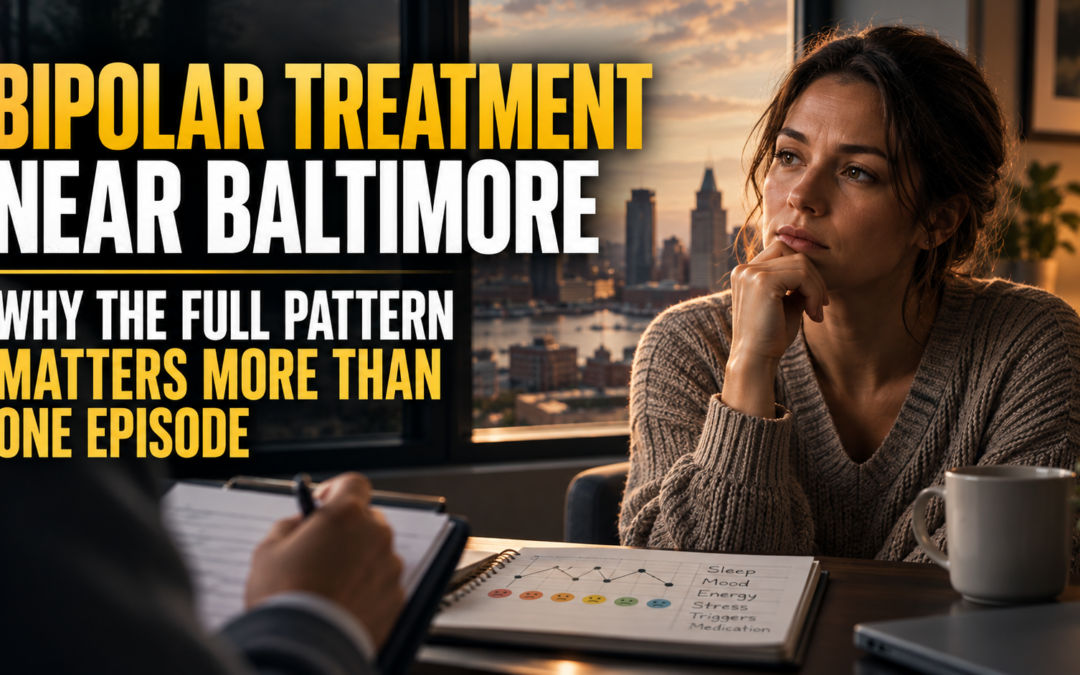
Bipolar disorder treatment near Baltimore often begins at a confusing moment, usually during a low stretch when getting out of bed feels impossible and the reason is hard to name. If you or someone you love has been treated for depression that never quite lifted, you may already sense that something is missing from the picture.
Maybe there were weeks when sleep barely seemed necessary. Ideas came fast, plans multiplied and spending or projects grew bigger than usual. At the time, those stretches may have felt like relief, so no one thought to mention them at a doctor’s appointment.
That is not a failure on your part. Mood conditions are hard to see from the inside, and a single appointment captures only a single moment. Families often notice the shifts first but feel unsure whether they are reading too much into them.
What matters now is that the full story can still be told. Bringing every piece into the room is how care starts to fit, and looking for answers today is a caring and hopeful step.
What Does Bipolar Disorder Treatment Near Baltimore Need to See First?
Bipolar disorder treatment near Baltimore needs to see the full pattern of a person’s moods over months or years, not only the episode that prompted the visit. The highs, the lows and the time between them together tell clinicians what condition they are actually treating.
A snapshot can mislead. A person in a depressive episode looks very similar to someone with depression alone, even though the two conditions call for different care.
What Is Bipolar Disorder?
Bipolar disorder is a mental health condition marked by shifts in mood, energy and activity that go beyond everyday ups and downs. It includes depressive episodes and elevated episodes called mania or hypomania.
Mania is an intense high that can disrupt work, relationships and safety. Hypomania is a milder high that may feel productive or even pleasant. Clinicians describe several types, including bipolar I, bipolar II and cyclothymic disorder, and each has its own pattern.
Why Does the Pattern Matter More Than One Episode?
The pattern matters because the diagnosis depends on how moods change across time, not on how someone feels on a given day. Think of it like judging a whole season from one rainy afternoon. You need the full forecast history to understand the climate.
Why Does Episode-by-Episode Treatment Fall Short?
Episode-by-episode treatment falls short because it responds to whatever mood a person is in right now while missing the cycle that keeps bringing the episodes back. Care that only reacts to each crisis rarely builds lasting stability.
Why Do Providers Usually See the Depressive Episode?
Providers usually see the depressive episode because that is when people feel distressed enough to ask for help. During hypomania, a person may feel confident, energized and capable, so it rarely occurs to them that anything needs attention.
As a result, many individuals receive a depression diagnosis first. That conclusion is understandable based on what the provider saw, yet it may describe only half of the story.
What Happens When Only the Low Is Treated?
When only the low is treated, the plan may not address the elevated episodes at all. For some people with bipolar disorder, an antidepressant used without a mood stabilizer can be linked to mood switching or faster cycling.
This is why bipolar disorder treatment near Baltimore should start with the whole history. The right medication approach depends on knowing whether highs are part of the picture.
What Does a Full Pattern Assessment Involve?
A full pattern assessment involves a detailed review of mood history, sleep, energy, family history, substance use and physical health, gathered over one or more conversations. It is careful by design, because accuracy shapes everything that follows.
A thorough evaluation often includes:
- A mood timeline that maps past episodes, how long they lasted and what came before them.
- Questions about elevated periods, such as reduced need for sleep, racing thoughts or unusual risk-taking.
- Family history, since mood conditions can run in families.
- Input from loved ones, shared with your permission, who may recall shifts you did not notice.
- Standardized screening tools such as the Mood Disorder Questionnaire.
- A medical review to rule out other causes, like thyroid problems or medication side effects.
- A substance use review, because alcohol and drugs can mimic or mask mood symptoms.
Why Does Family Input Help?
Family input helps because people who live alongside someone often see patterns from the outside. A partner may remember the summer of nonstop projects or the week of almost no sleep, details that feel ordinary to the person who lived them.
Is Mood Tracking Part of the Process?
Yes, many clinicians encourage mood charting, which means tracking mood, sleep and energy daily. Over a few weeks, those notes can reveal a rhythm that no single appointment could capture.
How Does Misdiagnosis Delay Recovery?
Misdiagnosis delays recovery because it sends treatment in the wrong direction, sometimes through years of trying approaches that never quite help. Each round of care that misses the mark can wear down hope and trust.
People in this situation often describe feeling unheard. They follow every recommendation, yet the cycle keeps returning, and they may start to wonder whether they are the problem.
They are not. When bipolar disorder treatment near Baltimore is built on an incomplete picture, even a committed person and a caring provider can struggle to make progress.
Can You Start Over With a New Evaluation?
Yes, a new evaluation is always possible, and it is often the turning point for people who have felt stuck. Sharing your complete history, including the periods that felt good, gives a care team what it needs to build a plan that fits.
How Are Bipolar Disorder and Substance Use Connected?
Bipolar disorder and substance use are closely connected because many individuals use alcohol or drugs to quiet a racing mind, ease a heavy low or stretch out an elevated mood. That relief is real in the moment, which is why the pattern can take hold quietly.
Over time, substances tend to make mood swings harder to manage. They can also blur the signs clinicians look for, since intoxication and withdrawal can resemble mood episodes.
Why Should Both Conditions Be Treated Together?
Both conditions should be treated together because each one feeds the other, and treating only one leaves the other free to pull a person back. This approach is called integrated or dual diagnosis care.
Integrated bipolar disorder treatment near Baltimore means one team understands your full story. Anxiety, trauma or attention difficulties that appear alongside mood shifts can be addressed in the same coordinated plan.
What Levels of Bipolar Disorder Treatment Near Baltimore Are Available?
Bipolar disorder treatment near Baltimore is available across several levels of care, and the right fit depends on symptoms, safety, substance use and daily responsibilities. Care can step up during harder stretches and step down as stability grows.
- Medically supervised detox helps a person safely stop using alcohol or drugs before mood treatment deepens.
- Residential treatment offers round-the-clock support and close medication monitoring in a calm setting.
- Partial hospitalization program (PHP) provides full days of treatment with evenings spent at home.
- Intensive outpatient program (IOP) includes several structured sessions each week around work or family.
- Outpatient care offers ongoing therapy, medication management and regular check-ins.
Therapy is a steady thread through every level. Approaches such as cognitive behavioral therapy (CBT) and psychoeducation help people recognize early warning signs, protect sleep and respond before a shift grows into an episode.
If you are unsure where to begin, the admissions team at Arrowwood Addiction Treatment Center can walk you through options for bipolar disorder treatment near Baltimore and suggest a clear starting point.
How Do You Know It Is Time to Seek Bipolar Disorder Treatment Near Baltimore?
It is time to seek bipolar disorder treatment near Baltimore when mood shifts affect your relationships, work, sleep or sense of stability, or when past treatment has not brought lasting relief. You do not need to reach a crisis to deserve care.
Consider these questions honestly:
- You have been treated for depression, and the low moods keep returning despite your effort.
- You remember periods of high energy, little sleep or racing ideas that felt different from your usual self.
- A medication once seemed to make you feel unusually wired, restless or agitated.
- You use alcohol or other substances to calm down, sleep or keep a good mood going.
- People close to you have noticed patterns in your moods that you did not see.
Recognizing yourself here does not mean something is wrong with you as a person. It means a fuller evaluation could help.
If you or someone you love is having thoughts of self-harm, please call or text the 988 Suicide and Crisis Lifeline right away. It is available 24 hours a day.
Common Questions Before Starting Treatment
How is bipolar disorder different from depression?
Bipolar disorder includes elevated episodes of mania or hypomania in addition to depressive lows. Depression alone does not include those highs, which is why a full history matters so much.
What if my hypomanic periods felt good?
That is very common, and it is still important to share them. Those periods are often the key detail that helps clinicians reach an accurate diagnosis.
Should my family be involved in the assessment?
With your permission, family input can be extremely helpful. Loved ones often remember mood shifts that are hard to see from the inside.
Can I keep working during treatment?
Often, yes. Intensive outpatient and outpatient programs are built around work and family schedules, and your care team can help you find a fit.
Seeing the Whole Picture Opens the Door to Stability
Bipolar disorder treatment near Baltimore works best when the full pattern is assessed, because every episode makes more sense once the highs, lows and spaces between them are understood together. If past care has felt incomplete, that experience is valid, and it is not the end of your story.
Stability looks different for everyone, and many individuals find steadier ground once their treatment finally matches their condition. With an accurate diagnosis and consistent support, the road ahead can feel clearer.
When you feel ready, reach out to Arrowwood Addiction Treatment Center to speak with a caring admissions team. They can answer your questions, explain your options and help you take the next step with confidence. You are not alone in this.